Cloud SaaS Completely Replacing Traditional Software? 2025 Enterprise Software Market Shake-Up
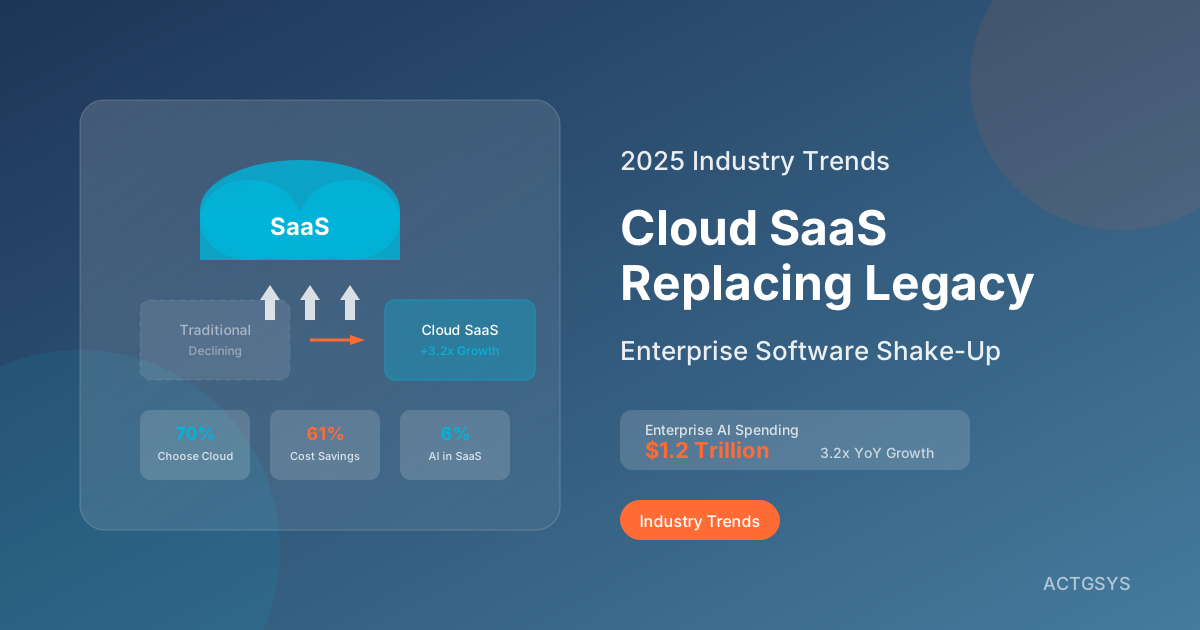
"Goodbye SaaS, AI is the future of enterprise software." This is the headline from AlixPartners' industry report released in early 2025, sparking heated discussion. In fact, we're witnessing the biggest transformation in enterprise software market history: AI-driven cloud SaaS is growing at 3x+ annually, while traditional perpetual-license software accelerates its decline. This article shows you this software revolution sweeping the globe.
2025 Enterprise Software Market Landscape
Impressive Growth Data
According to Menlo Ventures' 2025 State of Enterprise AI Report:
| Metric | 2024 | 2025 | Growth Rate |
|---|---|---|---|
| Enterprise AI Spending | NT$375B | NT$1.2T | 3.2x |
| AI Share of SaaS Market | 2% | 6% | 3x |
| AI SaaS Market Size | - | NT$1.2T | Fastest growth ever |
Enterprise AI Spending Allocation
Enterprise AI investment flows mainly to these areas:
Horizontal AI Applications (Cross-Industry)
├── Copilot/Assistants (86%) - NT$234B
│   ├── ChatGPT Enterprise
│   ├── Claude for Work
│   └── Microsoft Copilot
│
├── Code Generation (10%) - NT$130B (NT$18B last year)
│   ├── GitHub Copilot
│   ├── Cursor
│   └── Claude Code
│
└── Other Tools (4%)

Vertical AI Applications (Industry-Specific) - NT$114B
├── Financial Services
├── Healthcare
├── Manufacturing
└── Retail
SaaS vs Traditional Software: The Ultimate Showdown
Why is SaaS Winning?
| Comparison | Traditional Software | Cloud SaaS | Winner |
|---|---|---|---|
| Initial Cost | NT$500K-5M | NT$0 (monthly subscription) | SaaS |
| Deployment Time | 3-12 months | Instant~weeks | SaaS |
| Updates & Upgrades | Manual, extra fees | Auto, included | SaaS |
| Access Method | Company network only | Anywhere, any device | SaaS |
| Scalability | Repurchase needed | Flexible adjustment | SaaS |
| AI Features | Few, needs integration | Natively integrated, continuous updates | SaaS |
| Maintenance Burden | Needs IT staff | Vendor responsible | SaaS |
Gartner's Key Prediction
"By 2028, 33% of enterprise software applications will have built-in Agentic AI, compared to less than 1% in 2024. This will enable 15% of daily work decisions to be completed autonomously."
This means: Businesses adopting latest cloud SaaS will automatically enjoy AI upgrades; those using traditional software may need separate AI integration investments.
Cloud Transformation Status by Enterprise Software Type
ERP: Highest Cloud Penetration
| ERP Type | Market Share | Representative Products |
|---|---|---|
| Pure Cloud ERP | 45% | NetSuite, Acumatica |
| Hybrid Cloud ERP | 35% | SAP S/4HANA Cloud |
| On-Premise ERP | 20% | Traditional SAP, Oracle |
Trend Observation:
- Among new ERP implementations, over 70% choose cloud solutions
- SMEs almost 100% choose cloud ERP
- Large enterprises adopt hybrid cloud strategies
CRM: Most Mature Cloud Adoption
CRM is the earliest and most thoroughly cloud-adopted enterprise software category:
- Salesforce: Pure cloud pioneer, market leader
- HubSpot: SME favorite
- Zoho CRM: Best value choice
- Microsoft Dynamics 365: Deep Office 365 integration
Market Data:
- Cloud CRM market share exceeds 85%
- On-premise CRM only remains in large enterprise legacy systems
Accounting/Finance Software: Accelerating Transformation
| Software Type | Taiwan Status | Trend |
|---|---|---|
| Traditional Standalone | Still 40% | Rapidly declining |
| Local Server | 25% | Gradually phasing out |
| Cloud SaaS | 35% | Rapid growth |
Taiwan Characteristics:
- E-invoice policy accelerates cloud accounting adoption
- Ministry of Finance API promotes system integration
- SMEs gradually shifting from "packaged software" to "cloud services"
How AI is Disrupting SaaS?
From "Tool" to "Agent" Transformation
Traditional SaaS is a "tool"—waiting for user operation:
User logs in → Inputs data → Executes function → Views results
AI-driven SaaS is an "agent"—proactively completes tasks:
AI monitors data → Identifies opportunities/issues → Auto-executes → Notifies user of results
Practical Application Cases
| Traditional SaaS Method | AI SaaS Method |
|---|---|
| Manual customer data entry | AI auto-extracts from emails, business cards |
| Manually check inventory reports | AI alerts low inventory, auto-suggests purchasing |
| Regularly review accounts receivable | AI predicts overdue risk, auto-sends reminders |
| Manually create monthly reports | AI auto-generates and summarizes key points |
Major SaaS Vendors' AI Integration
| Vendor | AI Product | Core Functions |
|---|---|---|
| Salesforce | Einstein AI / Agentforce | Sales prediction, marketing automation |
| Microsoft | Dynamics 365 Copilot | Report generation, data analysis |
| ServiceNow | Now Assist | IT ticket automation |
| SAP | Joule | Enterprise process assistant |
| Oracle | AI Apps | Supply chain optimization |
SME Cloud Transformation Strategy
Evaluate Existing Systems
Signals Needing Transformation:
- Software version no longer supported
- Cannot remote access, affecting operations efficiency
- New features require additional paid modules
- Cannot integrate with other systems
- Maintenance costs increasing annually
- Lack AI/automation features
Cloud Transformation Paths
Path 1: Gradual Transformation
Existing system → Add cloud modules → Gradually migrate → Fully cloud
Timeline: 12-24 months
Suitable for: Mid-to-large enterprises with complex customizations
Path 2: Direct Replacement
Evaluate needs → Choose cloud solution → Data migration → Switch live
Timeline: 3-6 months
Suitable for: SMEs with simpler systems
Path 3: Hybrid Architecture
Maintain core system → Cloud peripheral systems → API integration
Timeline: 6-12 months
Suitable for: Industries with special compliance requirements
Cost Comparison: Traditional vs Cloud
Example: 20-person company ERP:
| Cost Item | Traditional Software (5 years) | Cloud SaaS (5 years) |
|---|---|---|
| Software License | NT$ 800,000 | NT$ 0 |
| Subscription Fees | NT$ 0 | NT$ 720,000 |
| Server Hardware | NT$ 300,000 | NT$ 0 |
| Maintenance Contract | NT$ 400,000 | NT$ 0 (included) |
| IT Staff | NT$ 600,000 | NT$ 100,000 |
| 5-Year Total Cost | NT$ 2,100,000 | NT$ 820,000 |
| Savings | - | 61% |
2025 Trends Worth Watching
Trend 1: Vertical AI SaaS Explosion
Industry-specific AI SaaS is growing rapidly:
- Manufacturing: Predictive maintenance, quality inspection
- Retail: Demand forecasting, inventory optimization
- Finance: Risk assessment, fraud detection
- Healthcare: Diagnostic assistance, medical record analysis
Market Size: Vertical AI SaaS reached NT$114B in 2025, 3x last year.
Trend 2: Code Generation Revolution
AI code generation tools are changing software development:
- One SaaS company CTO stated: "90% of our code is now AI-generated, compared to 10-15% twelve months ago."
- Evolution from "assisted coding" to "end-to-end automation"
- Impact on custom ERP/CRM development: drastically reduced costs, shortened cycles
Trend 3: Accelerating SaaS Consolidation
Major SaaS vendors are acquiring AI startups:
- ServiceNow acquired Moveworks for NT$93B
- Salesforce actively expanding Agentforce ecosystem
- Microsoft continuously enhancing Copilot features
Impact on SMEs: Choose SaaS vendors with integrated AI roadmaps, ensuring future feature continuous upgrades.
Frequently Asked Questions (FAQ)
Q1: My company is small, do we need to switch to cloud?
If you meet these conditions, strongly recommend switching:
- Fewer than 50 employees
- No dedicated IT staff
- Need remote/mobile work
- Want to reduce IT maintenance burden
Cloud SaaS advantages are more obvious for small companies: no server maintenance, auto-updates, pay-as-you-go.
Q2: Is data safe in the cloud?
Mainstream cloud SaaS providers' security levels typically exceed SME self-built:
- 24/7 security monitoring
- Multiple data backups
- International security certifications (ISO 27001, SOC 2)
- Regular penetration testing
Key is choosing reputable providers with transparent security policies.
Q3: Won't switching systems be troublesome?
Varies by system complexity:
- Simple systems (customer data, basic inventory): 1-2 weeks
- Medium complexity (including orders, purchasing): 1-2 months
- High complexity (multi-company, multi-currency): 3-6 months
Recommend finding experienced implementation consultants to significantly shorten timeline.
Q4: Isn't subscription more expensive long-term?
Need to calculate "Total Cost of Ownership" (TCO):
- Traditional software hidden costs: hardware, maintenance, upgrades, IT staff
- Cloud SaaS TCO typically 30-50% lower
- Cloud solutions continuously update, won't become "version obsolete"
Q5: Are there good cloud ERP/CRM choices in Taiwan?
Yes. Besides international brands (SAP, Salesforce, Microsoft), local solutions like ACTGSYS's Dinkoko ERP, DanLee CRM provide:
- Traditional Chinese interface
- Taiwan e-invoice integration
- Local technical support
- NT$ pricing
Conclusion: Embrace Cloud, Embrace Future
The 2025 enterprise software market is experiencing "AI explosion" and "complete cloud adoption" dual waves. For SMEs, this is both challenge and opportunity—early adopters will enjoy efficiency advantages, while observers may face competitive disadvantages.
Key Takeaways:
- AI-driven SaaS growing 3x+, traditional software accelerating decline
- Cloud solutions TCO typically 30-50% lower, with continuous auto-updates
- Choose vendors with AI integration roadmaps, ensuring future competitiveness
- Start small, gradually complete cloud transformation
Want to evaluate your cloud transformation options?
ACTGSYS Blueprint Thinking provides Dinkoko ERP, DanLee CRM, TanJee accounting and other cloud solutions, designed specifically for Taiwan SMEs to help you successfully complete digital transformation.
Related Articles
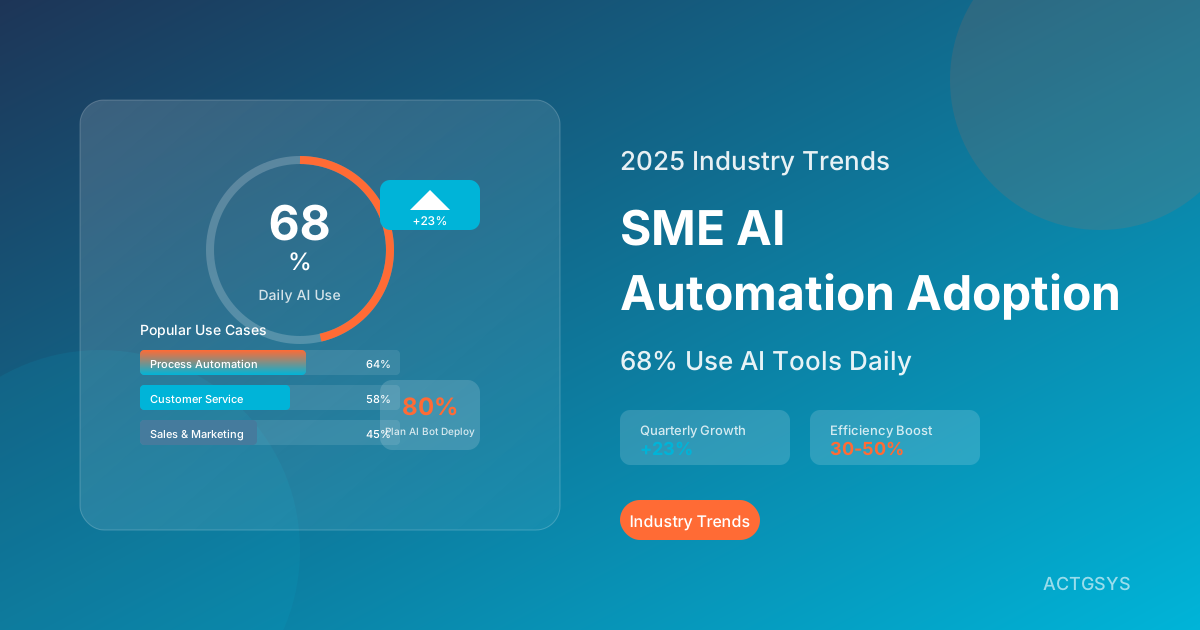
2025 SME AI Automation Adoption: 68% Now Use AI Tools Daily
Latest survey shows 68% of SMEs use AI automation tools daily, a 23% quarterly increase. In-depth analysis of popular AI applications, budget allocation, success factors, and AI adoption strategies for SMEs.
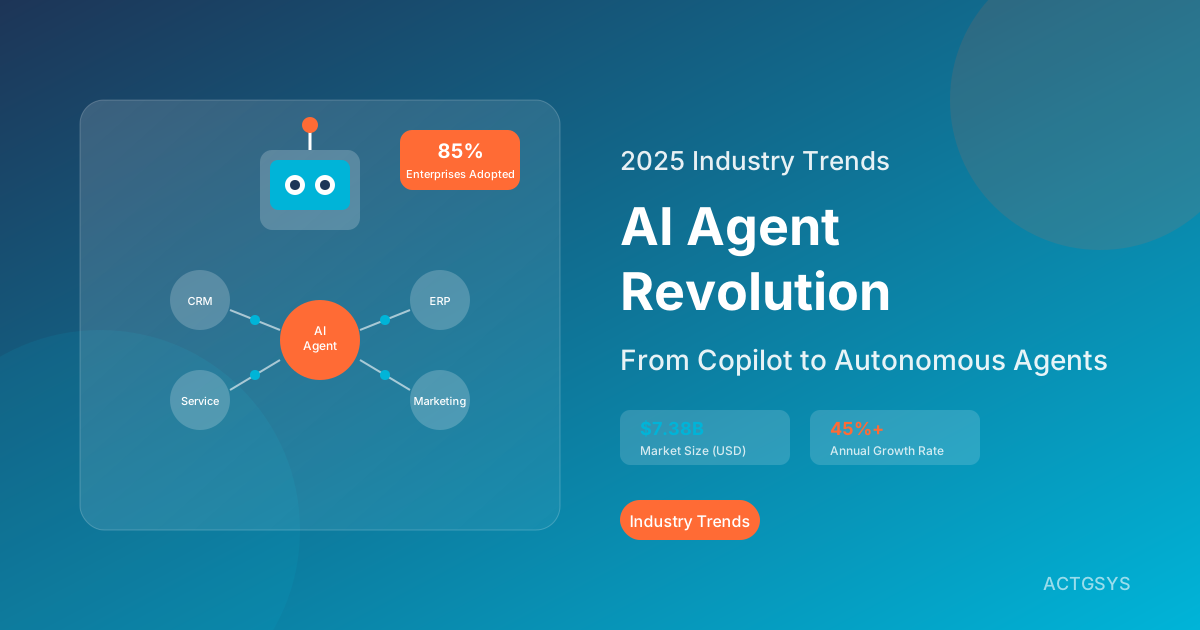
2025 AI Agent Revolution: Enterprise Automation Enters the 'Agent' Era
An in-depth analysis of 2025 AI Agent trends in enterprise applications. From Copilot to autonomous agents, learn how Salesforce, Microsoft, ServiceNow, and other tech giants are positioning themselves, and how SMEs can ride this AI automation wave.
DeepSeek Open Source AI: How Enterprises Can Leverage Cost Savings and Data Control
In-depth analysis of DeepSeek's open-source AI impact on enterprises, comparing cost-effectiveness of open vs closed source solutions, and how SMEs can leverage open-source AI for cost reduction and data sovereignty.