2025 AI Agent Revolution: Enterprise Automation Enters the 'Agent' Era
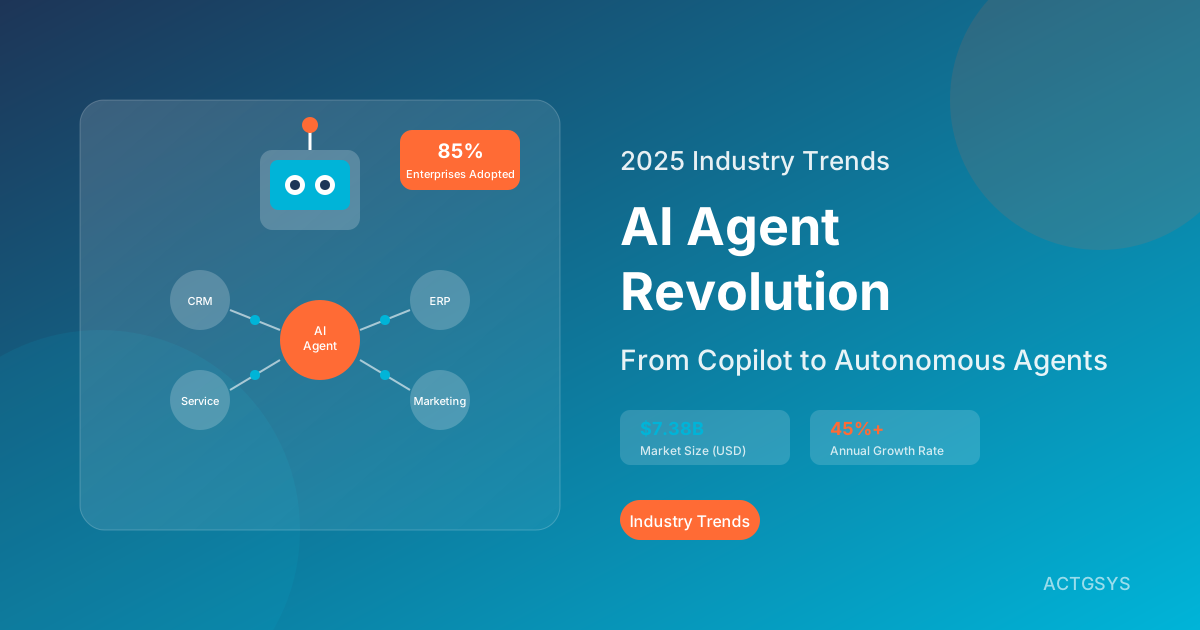
In 2025, enterprise AI applications are undergoing a paradigm shift. From passive "Copilots" to proactive "Autonomous Agents," this isn't just a technology upgrade—it's a fundamental transformation in how businesses operate. According to the latest data, the global AI Agent market has reached $7.38 billion, and is projected to grow to $103.6 billion by 2032. This article takes you deep into understanding how this "Agent Revolution" impacts enterprises.
What is an AI Agent? How Does It Differ from Copilot?
Definition of AI Agent
An AI Agent (Intelligent Agent) is an AI system capable of autonomously setting goals, making decisions, and taking actions. Unlike traditional AI tools that require human commands to operate, AI Agents can:
- Proactively identify problems and propose solutions
- Autonomously plan and execute multi-step tasks
- Adjust strategies in real-time based on environmental changes
- Collaborate with other systems and Agents to complete complex work
Copilot vs Agent: Key Differences
| Feature | AI Copilot | AI Agent |
|---|---|---|
| Operating Mode | Passively waits for commands | Proactively discovers and solves problems |
| Decision Authority | Human decides, AI assists | AI decides autonomously, human supervises |
| Task Scope | Single task assistance | End-to-end process automation |
| Interaction Method | Conversational Q&A | Goal-oriented execution |
| Typical Applications | Writing emails, summarizing documents | Auto-handling complaints, managing inventory |
Evolution from Copilot to Agent
2023-2024: Copilot Era
"Help me write a reply email to this customer"
↓ Human gives command → AI executes single task

2025+: Agent Era
"Handle this customer's return request"
↓ AI autonomously: Query order → Check return policy → Process refund → Update inventory → Notify customer
2025 AI Agent Market Overview
Explosive Growth Data
According to multiple industry reports, AI Agents are penetrating enterprise applications at an astonishing rate:
| Metric | Data |
|---|---|
| 2025 Global Market Size | ~$7.38 billion |
| 2032 Projected Size | ~$103.6 billion |
| CAGR | 45%+ |
| Enterprises with Deployed AI Agents | 85% |
| Currently Experimenting with Agent Tech | 62% |
Primary Application Areas
Main scenarios for enterprise AI Agent adoption:
-
Business Process Automation (64%)
- Customer service ticket processing
- HR administrative processes
- Procurement approval workflows
-
Customer Service (58%)
- Intelligent customer service bots
- Automatic issue classification and routing
- Customer sentiment analysis
-
Sales & Marketing (45%)
- Lead scoring
- Personalized recommendations
- Marketing campaign optimization
-
IT Operations (40%)
- Service desk automation
- Anomaly detection and remediation
- System monitoring
Tech Giants' AI Agent Strategies
Salesforce: Agentforce
Salesforce's Agentforce platform, launched in late 2024, has achieved:
- 5,000+ closed deals
- Over 3,000 paying customers
- Einstein AI integration for predictive analytics and automation
Core Features:
- Sales Agent: Auto-follow-up with leads
- Service Agent: Handle customer inquiries and complaints
- Marketing Agent: Optimize campaign delivery
Microsoft: Dynamics 365 + Copilot
Microsoft is deeply integrating Copilot (based on OpenAI technology) into Dynamics 365:
- Real-time Assistance: Draft reports, analyze data
- Process Automation: Across finance, supply chain, CRM functions
- Intelligent Insights: Auto-discover business opportunities and risks
ServiceNow: Moveworks Acquisition
ServiceNow acquired Moveworks for $2.85 billion in March 2025, demonstrating enterprise software giants' strategic investment in Agent technology.
Integration Direction:
- Full IT service desk automation
- HR process intelligence
- Operational workflow optimization
Real Benefits of Enterprise AI Agent Adoption
Verified ROI Data
Early AI Agent adopters are seeing significant benefits:
| Application Scenario | Benefit Metric | Data |
|---|---|---|
| ERP/CRM Workflows | Process Cycle Reduction | 20-30% |
| Customer Service | Efficiency Improvement | Up to 50% |
| IT Service Desk | Ticket Auto-Resolution Rate | 60%+ |
| Logistics Optimization | Revenue Growth | 61% above peers |
| Manufacturing OEE | Equipment Efficiency Improvement | 85% |
Case Study: US Freight Brokerage Company
A 45-person freight brokerage company after deploying AI Agents:
- Processed 30% more shipments per week
- Zero additional headcount
- Employees freed to focus on high-value customer relationships
Prediction: 2029 Customer Service Automation
According to Gartner predictions, by 2029:
- 80% of customer service issues will be autonomously resolved by AI Agents
- No human intervention required
- Over 34 billion customer interactions processed annually (only 3.3 billion in 2025)
How SMEs Can Ride the AI Agent Wave
Practical Implementation Strategy
For resource-limited SMEs, the following strategy is recommended:
Phase 1: Choose Mature SaaS Agent Tools
- Customer service chatbots (LINE Bot, Website Chat)
- Email auto-reply and classification
- Meeting scheduling assistants
Budget: $50-500/month Benefit: Save 20-40% customer service/admin time
Phase 2: Integrate with Existing Systems
- CRM + AI Agent (auto customer follow-up)
- ERP + AI Agent (smart inventory alerts)
- Accounting + AI Agent (auto reconciliation)
Budget: $10,000-30,000 Benefit: 40-60% process automation rate
Phase 3: Custom Agent Development
- Build dedicated Agents based on business specifics
- Multi-system composite Agents
- Industry-specific knowledge bases
Budget: $30,000-100,000 Benefit: Competitive differentiation, 50%+ efficiency gains
Key Questions for Evaluating AI Agents
Before implementation, consider these questions:
-
Clear Business Pain Points
- Which processes consume the most staff time?
- Which decisions can be standardized?
-
Data Readiness
- Is there sufficient historical data to train the Agent?
- Is data quality adequate?
-
Human-Machine Collaboration Design
- What's the human intervention mechanism when Agent fails?
- How to monitor Agent decision quality?
-
Success Metrics
- How to quantify Agent benefits?
- How often to evaluate ROI?
2025 AI Agent Challenges and Risks
Implementation Barriers
According to Gartner research:
- 42% of enterprises making only conservative investments
- 31% still watching and waiting
- 62% don't know where to start
- 32% stuck in pilot phase, unable to scale to production
Primary Risks
| Risk Type | Description | Mitigation Strategy |
|---|---|---|
| Decision Errors | Agent may make inappropriate decisions | Set decision boundaries, require human confirmation for critical decisions |
| Security Risk | Agent accessing sensitive data | Principle of least privilege, audit logs |
| Compliance Issues | Legal liability for automated decisions | Ensure explainability, maintain decision trails |
| Over-Dependence | Employee skill degradation | Human-machine collaboration design, continuous training |
Frequently Asked Questions
Q1: Will AI Agents replace employees?
Not in the short term on a large scale, but they will change job content. According to research, AI Agents primarily replace "repetitive, rule-based" tasks, allowing employees to focus on creative, judgment-based, and interpersonal high-value work. Enterprises should position AI Agents as "super assistants" rather than "replacements."
Q2: Can small companies use AI Agents?
Yes. There are now many low-barrier AI Agent tools:
- ChatGPT/Claude API integration
- LINE Official Account + AI customer service
- Zapier/Make AI automation workflows
You can start using basic features from $50-150/month.
Q3: How to ensure AI Agent decision quality?
Recommended practices:
- Set clear decision boundaries (what can be autonomous, what needs human input)
- Continuously monitor Agent output quality
- Establish feedback mechanisms for Agent learning from mistakes
- Regular human spot-checks and corrections
Q4: How much budget is needed to implement AI Agents?
Varies by scale:
- Entry-level (SaaS tools): $500-5,000/year
- Integration-level (Connect with existing systems): $10,000-30,000
- Custom-level (Dedicated development): $30,000-150,000
Recommend starting at entry-level, validate benefits, then expand.
Q5: Are there AI Agent solutions available in Taiwan?
Yes. Besides international giants (Microsoft, Salesforce) with Taiwan distributors, local providers like ACTGSYS also offer AI customer service bots, LINE Bot integration, and other solutions, with advantages in Chinese context understanding and localized service.
Conclusion: The Agent Era Has Arrived
2025 is the pivotal year for AI Agents transitioning from "experimentation" to "production." Regardless of your enterprise size, now is the best time to evaluate AI Agent applications.
Remember the advice from Reddit communities:
"The key to implementing AI Agents is aligning with real business needs, ensuring they 'reduce' rather than 'increase' workload."
Start with a small-scope pilot, validate benefits, then gradually expand—this is the most practical implementation strategy.
Want to learn how to implement AI Agents for your enterprise?
ACTGSYS provides AI customer service bots, LINE Bot integration, and enterprise process automation solutions to help you ride this AI Agent wave.
Related Articles
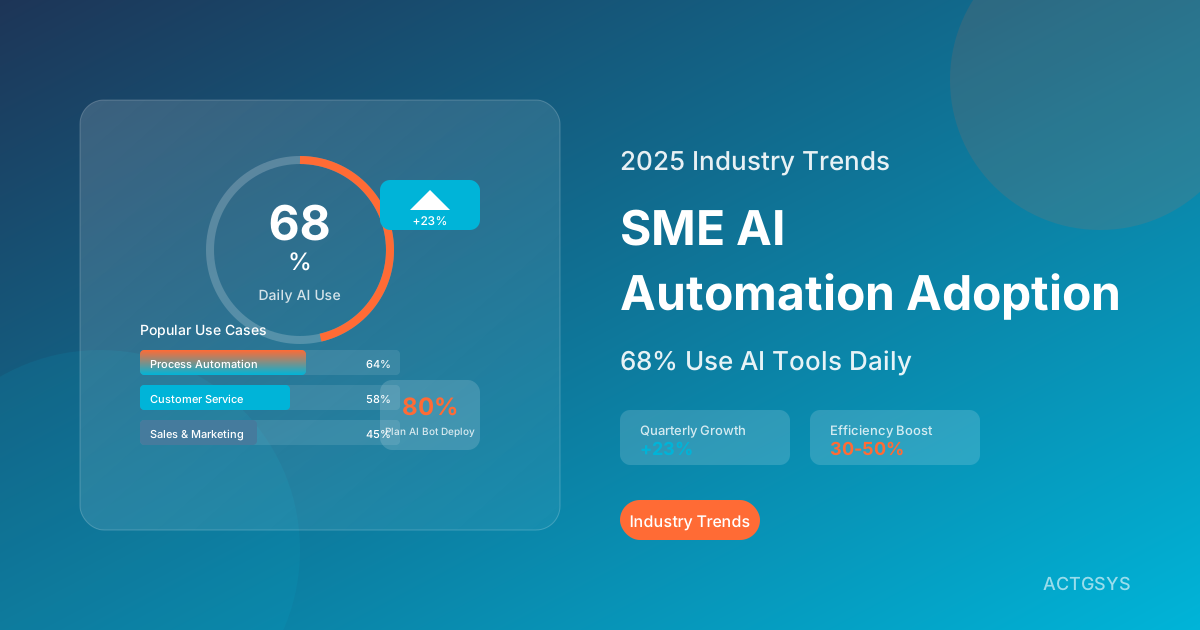
2025 SME AI Automation Adoption: 68% Now Use AI Tools Daily
Latest survey shows 68% of SMEs use AI automation tools daily, a 23% quarterly increase. In-depth analysis of popular AI applications, budget allocation, success factors, and AI adoption strategies for SMEs.
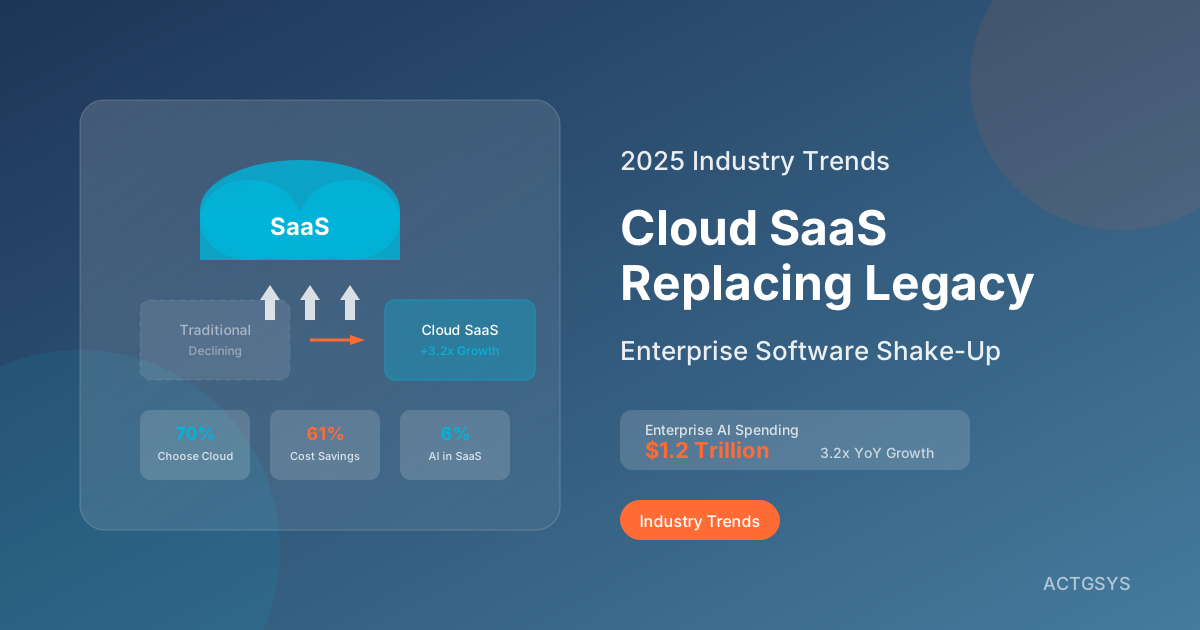
Cloud SaaS Completely Replacing Traditional Software? 2025 Enterprise Software Market Shake-Up
In-depth analysis of cloud SaaS impact on traditional enterprise software in 2025. From ERP, CRM to accounting systems, understand the NT$1.2 trillion AI revolution in enterprise software market and how SMEs should respond to this transformation wave.
DeepSeek Open Source AI: How Enterprises Can Leverage Cost Savings and Data Control
In-depth analysis of DeepSeek's open-source AI impact on enterprises, comparing cost-effectiveness of open vs closed source solutions, and how SMEs can leverage open-source AI for cost reduction and data sovereignty.