How to Choose an Accounting System for SMEs: Software Comparison and Selection Guide
Financial management is the lifeblood of business operations, but many SME owners are confused about accounting system selection: Is Excel sufficient, or do you need professional accounting software? This article provides an in-depth analysis of accounting system selection criteria for small and medium enterprises.
Why Do You Need a Professional Accounting System?
Many early-stage business owners are accustomed to using Excel for bookkeeping, but as the business grows, the limitations of this approach become increasingly apparent:
Common Problems with Excel Bookkeeping
- High risk of human error: Formula mistakes, copy-paste errors
- Lack of audit trail: Who changed what, when—impossible to track
- Time-consuming report generation: Monthly closing requires extensive manual processing
- No multi-user collaboration: Simultaneous editing easily causes version confusion
- Tax compliance difficulties: Format doesn't meet filing requirements
Advantages of Professional Accounting Systems
| Function | Excel | Accounting System |
|---|---|---|
| Auto-posting | Manual | Automatic |
| Report generation | Manual work required | One-click generation |
| Audit trail | None | Complete records |
| Multi-user collaboration | Difficult | Supported |
| Tax integration | Conversion needed | Direct filing |
Essential Features for SME Accounting Systems
Core Feature 1: Voucher Management
Vouchers are the foundation of accounting systems. Comprehensive voucher management should include:
- Multiple voucher types: Income, expense, transfer vouchers
- Auto-generated entries: Reduce manual input
- Voucher review mechanism: Ensure accounting accuracy
- Attachment upload: Digital preservation of original documents
Core Feature 2: Financial Statements
What bosses care most about is reports. The system should automatically generate:
- Balance Sheet: Understand company financial position
- Income Statement: Track profitability
- Cash Flow Statement: Monitor cash movement
- Trial Balance: Verify accounting accuracy
- General Ledger/Sub-ledger: Detailed transaction records
Core Feature 3: Tax Compliance
SMEs must comply with tax regulations:
- Sales tax filing: Automatic generation of required forms
- Corporate tax integration: Annual filing data preparation
- Electronic invoicing: Issuance, receipt, and archiving
- Withholding tax filing: Various income withholding data management
Advanced Features
Depending on business needs, you may also require:
- Multi-currency support: Essential for import/export trading
- Department/Project coding: Management accounting needs
- Budget management: Expense control
- Bank reconciliation: Auto-matching of bank statements
Accounting System Type Comparison
Type 1: Desktop Installation
Characteristics
- Installed on company computers
- One-time license purchase
- Data stored locally
Suitable For
- High data security concerns
- Dedicated IT staff for maintenance
- No remote access needed
Examples: Traditional packaged accounting software
Type 2: Cloud Subscription
Characteristics
- Access via browser
- Monthly/annual subscription
- Data stored in cloud
Suitable For
- Need anytime, anywhere access
- Want to reduce initial investment
- Multi-location or remote work requirements
Examples: Modern SaaS accounting systems
Type 3: Integrated (ERP Built-in)
Characteristics
- Integrated with inventory management
- Transactions automatically generate accounting entries
- Reduces duplicate input
Suitable For
- Already using ERP systems
- Want unified financial and operational data
- Pursuing process automation
Selection Evaluation Criteria
Evaluation 1: Regulatory Compliance
Confirm the system meets:
- Commercial accounting regulations
- Sales tax filing formats
- E-invoice integration standards
- Corporate tax filing requirements
Evaluation 2: Ease of Use
Consider user acceptance:
- Is the interface intuitive?
- Does it require accounting expertise?
- Are there learning resources and customer support?
Evaluation 3: Integration with Existing Systems
Assess integration needs:
- Can it connect with existing inventory systems?
- Does it support bank statement import?
- Can it integrate with e-invoice systems?
Evaluation 4: Cost Considerations
Calculate total cost of ownership:
- Software fees (perpetual vs subscription)
- Implementation and training costs
- Annual maintenance fees
- Customization development costs
Accounting System Implementation Steps
Step 1: Set Up Chart of Accounts
- Configure company's accounting accounts
- Reference standard account templates
- Adjust according to industry characteristics
Step 2: Set Opening Balances
- Import previous period ending balances
- Confirm assets and liabilities balance
- Verify general ledger matches sub-ledger
Step 3: Create Common Entry Templates
- Fixed asset depreciation setup
- Prepaid expense amortization
- Payroll entries
Step 4: Integrate Other Systems
- Connect inventory management system
- Set up e-invoice integration
- Configure bank reconciliation
Step 5: Training
- Professional training for accounting staff
- Report interpretation for managers
- Create operation manuals
TanJee - Accounting System Designed for SMEs
ACTGSYS is launching TanJee Accounting System, built specifically for small and medium enterprises:
Core Features
- Intuitive Interface: Easy for non-accountants to use
- AI Smart Classification: Automatic account suggestions
- Complete Tax Integration: Sales tax and corporate tax in one place
- Seamless ERP Integration: Data sync with Dinkoko ERP
- Cloud Real-time Access: Bosses can check financial reports anytime
Integration with ACTGSYS Product Ecosystem
TanJee integrates seamlessly with other ACTGSYS products:
DanLee CRM    →    Dinkoko ERP    →    TanJee
(Customer Mgmt)    (Inventory)        (Accounting)
    ↓                  ↓                 ↓
Deal Closed    →   Ship/Receive    →   Auto-generate Voucher
Frequently Asked Questions
Q: Do small companies need accounting software?
A: Depends on transaction volume and management needs. Generally, businesses with over 50 transactions per month, or those needing formal financial statements, should use professional accounting systems.
Q: Is cloud accounting secure?
A: Modern cloud systems typically have bank-grade security:
- Encrypted data transmission and storage
- Multiple backup mechanisms
- Access permission controls
- Regular security audits
Q: Do I need a full-time accountant?
A: Depends on business size. Small businesses can:
- Use simple systems for self-bookkeeping
- Have accountant/CPA review monthly
- Outsource annual tax filing to CPAs
Q: How long does accounting system implementation take?
A: Typical SMEs need about 2-4 weeks:
- System setup: 3-5 days
- Data migration: 3-5 days
- Training: 3-5 days
- Parallel testing: 1-2 weeks
Conclusion
Choosing the right accounting system not only improves financial management efficiency but also provides timely, accurate financial information for business decisions. The key is finding a solution that fits your business size, industry characteristics, and integrates with existing systems.
Want to learn more about TanJee Accounting System? Register now to get early access to powerful features coming soon!
Related Articles
No-Code/Low-Code Platforms 2026: The Complete SME Automation Guide
Comprehensive analysis of 2026 No-Code/Low-Code market trends, covering Citizen Developers, AI-assisted development, and platform selection to help SMEs achieve rapid business automation.
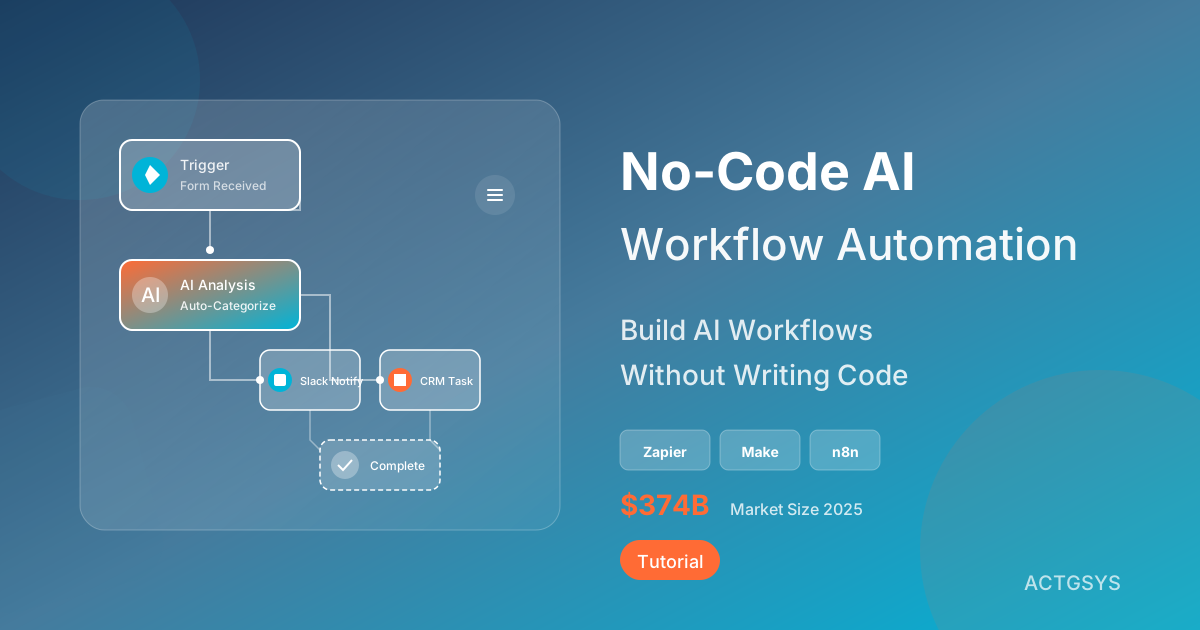
No-Code AI Workflow Automation: How SMEs Can Implement AI Without Developers
Explore the hottest No-Code AI automation tools of 2025, including Zapier AI, Make, and n8n. Learn how to build AI workflows using natural language, enabling non-technical staff to achieve enterprise automation with 80% efficiency gains.
What is ERP? Complete Guide to Inventory Management Systems for SMEs
A comprehensive guide to ERP enterprise resource planning systems: from basic inventory management functions to implementation best practices. Learn how to select the right ERP system for your business and optimize inventory and order management.