E-commerce CRM Success Cases: 46% Revenue Growth Real Experience
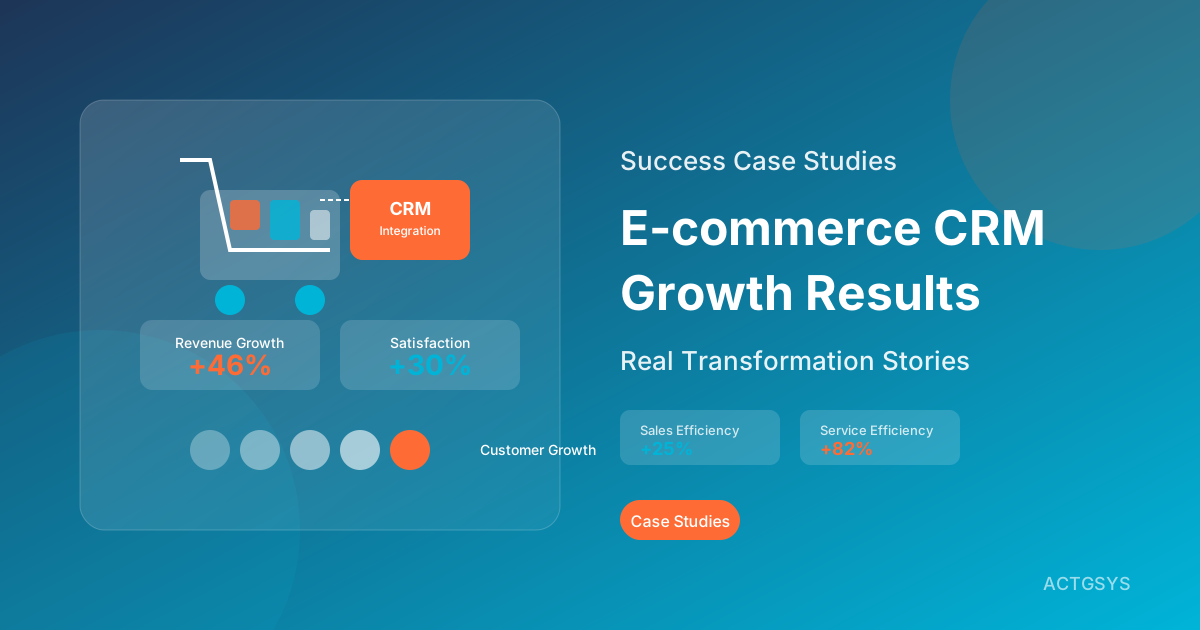
"Does implementing CRM really work?" This is the question many e-commerce owners ask. This article compiles real e-commerce CRM implementation cases from 2024-2025, from data to actual practices, showing you how CRM helps e-commerce businesses achieve revenue doubling growth.
Case 1: UK Retail Chain — 30% Customer Satisfaction Boost
Company Background
A major UK retail chain (unnamed due to confidentiality), operating for years, faced these challenges:
- Customer data scattered across different systems
- Store and online channel information not synced
- Inconsistent customer service quality
- Unable to track complete customer purchase journey
Solution Deployed
The company chose to integrate Adobe Commerce (Magento) with CRM system, creating unified customer view.
Integration Scope:
- E-commerce platform transaction data
- Store POS systems
- Customer service ticketing system
- Marketing automation tools
Actual Results
| Metric | Before | After | Improvement |
|---|---|---|---|
| Customer satisfaction | 62% | 80.6% | +30% |
| Service response consistency | Poor | Excellent | Greatly improved |
| Cross-channel data sync | None | Real-time | Complete integration |
| 360-degree customer view | None | Complete | New feature |
Key Success Factors
- Unified customer identification: Recognize same person regardless of contact channel
- Real-time data sync: Store purchases immediately reflected in online account
- Service knowledge base integration: Service staff can instantly view complete customer history
- Marketing automation: Auto-send relevant recommendations based on purchase behavior
Case 2: B2B Wholesaler — 25% Sales Efficiency Improvement
Company Background
A B2B wholesale company with thousands of enterprise customers, facing problems:
- Massive customer data difficult to manage
- Low sales follow-up efficiency
- Serious opportunity loss
- Lack of systematic sales process
Solution Deployed
Implemented CRM system with key features:
- Sales pipeline automation: Complete tracking from lead to deal
- Customer tier management: Auto-classification by contribution
- Follow-up reminder system: Auto-notify sales of customers to contact
- Quote management: Standardized quotation process
Actual Results
| Metric | Before | After | Improvement |
|---|---|---|---|
| Sales efficiency | Baseline | - | +25% |
| Opportunity conversion rate | 12% | 18% | +50% |
| Average deal cycle | 45 days | 32 days | -29% |
| Customer data completeness | 60% | 95% | +58% |
Key Success Factors
- Sales process standardization: Defined clear stages and actions
- Automated follow-ups: System auto-reminds, no missed opportunities
- Data-driven decisions: Management can see sales funnel status in real-time
- Team collaboration: Shared customer information, avoid duplicate contact
Case 3: Eye-oo Italian Eyewear E-commerce — $175K Additional Revenue
Company Background
Eye-oo is an Italian online eyewear retailer facing challenges at end of 2023:
- Long customer service response times (2-5 minutes)
- Repetitive questions consuming manpower
- High lead loss rate
- Website conversion rate needs improvement
Solution Deployed
Implemented Tidio Live Chat + Lyro AI Chatbot:
- AI auto-reply to common questions
- Smart lead capture
- Live human service transfer
- Conversation data analysis
Actual Results
Impressive Data:
| Metric | Data |
|---|---|
| Additional revenue contribution | $175,000 (€177,000) |
| Overall sales growth | +25% |
| First response time | From 2-5 minutes → 30 seconds (-86%) |
| AI auto-handled inquiries | 82% (1,831 out of 2,233) |
| Auto-captured leads | 1,305 |
Key Success Factors
- AI handles repetitive questions: 82% of inquiries auto-resolved by AI
- Instant response: Response time from minutes to seconds
- Proactive lead capture: Browsers converted to trackable potential customers
- Human-AI collaboration: Complex issues seamlessly transferred to human service
Case 4: EcoHome Furniture — 46% Revenue Growth
Company Background
EcoHome Furniture is a Manchester, UK furniture e-commerce that decided on digital transformation in late 2024.
Pre-implementation Challenges:
- Slow order processing
- Inventory and e-commerce platform not synced
- Procurement decisions lack data support
- Tedious accounting work
Solution Deployed
Adopted Cloud ERP Integration Solution, connecting:
- Shopify e-commerce platform
- Inventory management module
- Procurement management
- Accounting system
Actual Results
| Metric | Improvement |
|---|---|
| Revenue growth | +46% |
| Order processing speed | Significantly improved |
| Inventory accuracy | Nearly 100% |
| Manual work reduction | Noticeably decreased |
Key Success Factors
- Omnichannel integration: E-commerce, inventory, accounting end-to-end
- Real-time inventory sync: Avoid overselling and stockouts
- Automated order process: From order to shipment fully automated
- Data-driven procurement: Smart restocking based on sales trends
Case 5: CarMax US Used Car E-commerce — 50M Daily Recommendations
Company Background
CarMax is America's largest used car retailer, achieving online-offline integration through digital transformation.
Innovation
Built Customized CRM + AI Recommendation System:
- Integrated online browsing and in-store visit data
- AI/ML-driven personalized recommendations
- Omnichannel customer experience
Actual Results
| Metric | 2024 Data |
|---|---|
| Daily car recommendations | 50 million |
| Retail used car sales | +5.4% |
| Wholesale sales | +6.3% |
| Customer experience | Seamless online-offline |
Implications for E-commerce
While CarMax is large-scale, its strategies can be applied smaller to SME e-commerce:
- Unify online-offline customer data
- Use AI for personalized recommendations
- Create seamless omnichannel experience
Common Success Patterns in E-commerce CRM
Pattern 1: Unified Customer View
Problem: Customer data scattered across different systems
Solution:
E-commerce platform ─┐
                     ├──→ CRM unified customer database ──→ 360° customer view
Service system ──────┤
                     │
Store POS ───────────┘
Benefit: 20-30% customer satisfaction improvement
Pattern 2: Sales Process Automation
Problem: Untimely opportunity follow-up, low conversion rate
Solution:
Lead entry → Auto-scoring → Auto-assignment → Follow-up reminder → Deal tracking
Benefit: 25%+ sales efficiency improvement
Pattern 3: AI Customer Service Integration
Problem: High customer service costs, slow response
Solution:
Customer inquiry → AI judges type → Simple questions AI answers (80%)
                       → Complex questions transfer to human (20%)
Benefit: 50-60% customer service cost reduction, satisfaction improvement
Pattern 4: Omnichannel Integration
Problem: Different channel data not synced
Solution:
Website orders ─┐
                ├──→ Central ERP/CRM ──→ Unified inventory
LINE orders ────┤                     ──→ Unified customer data
                │                     ──→ Unified reports
Store orders ───┘
Benefit: 30-46% revenue growth
E-commerce CRM Recommendations for SMEs
Solution Selection by Revenue Scale
| Annual Revenue | Recommended Solution | Budget Range |
|---|---|---|
| Under $150K | LINE OA + Simple CRM | $300-1,500/year |
| $150K-600K | Cloud CRM (DanLee/Zoho) | $1,500-6,000/year |
| $600K-3M | CRM + ERP Integration | $6,000-24,000/year |
| Over $3M | Custom Integration Solution | $24,000+/year |
Implementation Priority Recommendations
Phase 1 (1-2 months):
- Customer data centralization
- Basic sales pipeline setup
- Service ticket management
Phase 2 (2-4 months):
- AI customer service chatbot
- Marketing automation
- Data reports
Phase 3 (4-6 months):
- ERP integration
- Omnichannel sync
- Advanced analytics
Frequently Asked Questions
Q1: Do small e-commerce businesses need CRM too?
Yes. Even with just 100 customers, CRM helps you:
- Remember each customer's purchase preferences
- Auto-remind of repurchase timing
- Track customer service conversation history
Start with free or low-cost plans (like HubSpot free version, DanLee).
Q2: What's the difference between CRM and e-commerce platform membership systems?
E-commerce platform membership systems:
- Only record transactions on that platform
- More basic features
- Difficult to integrate other channels
CRM systems:
- Integrate all channel customer interactions
- Complete sales/marketing automation
- Customizable process design
Q3: How much manpower needed to implement CRM?
Depends on scale:
- Small e-commerce (1-5 people): Owner or one employee can manage
- Medium e-commerce (5-20 people): Recommend 1 dedicated person
- Large e-commerce (20+ people): Need dedicated team
Key is choosing user-friendly system to reduce learning cost.
Q4: How to evaluate if CRM implementation succeeds?
Recommend tracking these metrics:
- Customer repurchase rate change
- Sales conversion rate change
- Customer service response time
- Customer satisfaction score
- Revenue/profit change
3-6 months after implementation, should see noticeable improvement.
Q5: Are there CRMs suitable for e-commerce?
Yes. Besides international solutions, local options include:
- DanLee CRM: Local language interface, messaging app integration, local currency pricing
- Various e-commerce platform CRM plugins
- Local consultant custom solutions
Recommend choosing vendors with e-commerce integration experience.
Conclusion: CRM is E-commerce Growth Accelerator
From these cases, e-commerce businesses successfully implementing CRM commonly achieve:
- 20-30% customer satisfaction improvement
- 25%+ sales efficiency improvement
- 25-46% revenue growth
The key isn't choosing the most expensive or feature-rich CRM, but:
- Choose solution suitable for your scale
- Actually execute customer data integration
- Utilize automation features well
- Continuously optimize and expand
As one industry observer said:
"If 2024 was the year of digital awakening, 2025 is the year of digital acceleration."
Want to learn about the best CRM solution for your e-commerce business?
ACTGSYS offers DanLee CRM, designed for local e-commerce, supporting messaging app integration and e-commerce platform connections, helping you achieve customer relationship management digitalization.
Related Articles
Manufacturing ERP Digital Transformation: 85% Equipment Efficiency Boost, 43% Fewer Quote Revisions
In-depth analysis of real manufacturing ERP success cases. From German STIHL power tools to global brand P&G, learn how ERP integration achieved 85% equipment efficiency improvement and 20-30% shorter process cycles.
AI Customer Service Chatbot Success Cases: Save 330 Hours Monthly, Boost Satisfaction
In-depth analysis of real AI customer service chatbot success cases. From banks handling 3.5M daily inquiries to insurance companies saving 330 hours monthly, learn how to achieve 82% auto-resolution rate and 86% faster response times.
What is CRM? 2025 Complete Customer Relationship Management Guide for SMEs
A comprehensive guide to CRM systems: from basic concepts to implementation best practices. Learn how to select and implement the right CRM system to improve sales and customer management for your business.